
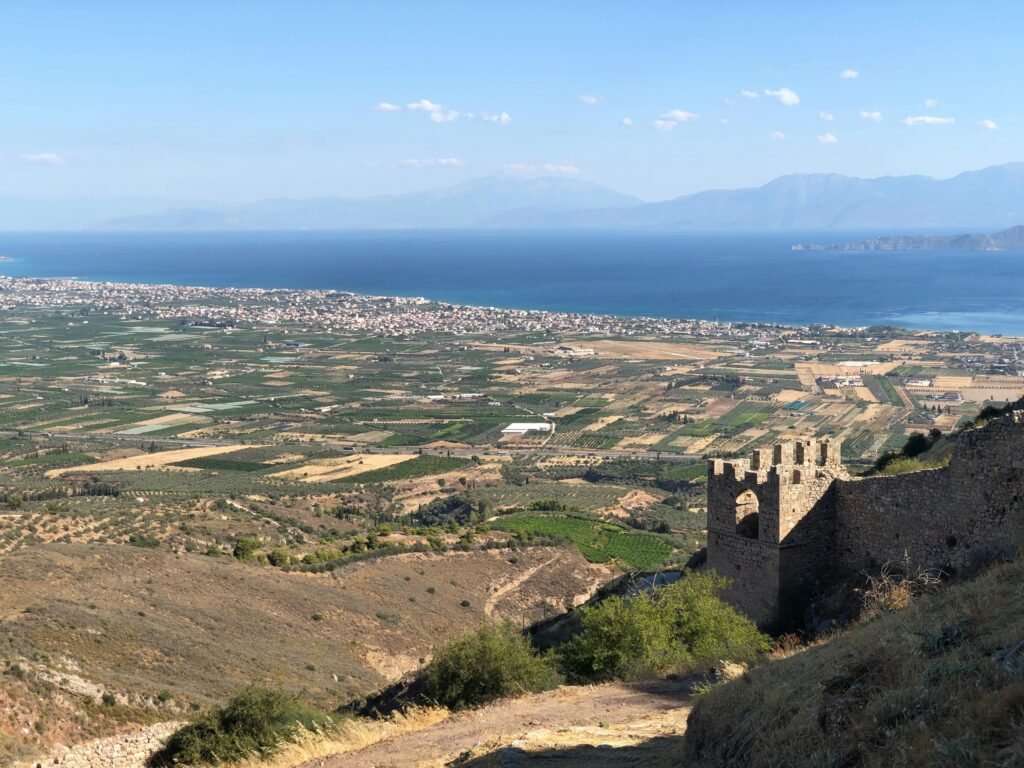
Why Invest in the Peloponnese: A Legal & Market Guide for Foreign Investors
From the Corinthian Gulf to Porto Heli — guided by Your Legal Home led by Kotsonis–Gaitanaki Law Firm, based in Corinthia, working across the region.
The Peloponnese has been continuously inhabited for over three thousand years. That history is not a background detail. It is a legal fact — and it is at the core of what makes this market both compelling and distinctive.
Ancient Corinth, Mycenae, Tiryns, Epidaurus, Nafplio. The density of archaeological heritage in Corinthia and the Argolida is unmatched in mainland Greece. And the legal framework that protects that heritage — archaeological zone designations, coastal protection rules, the published forest map — is also the framework that constrains the supply of legally clear, developable land near Greece’s most sought-after coastline.
For a sophisticated investor, legal complexity and investment value are the same thing seen from different angles. The properties that are hardest to develop carelessly are also the ones most protected from oversupply. Getting the legal foundation right is not a step before the investment. It is the investment.
The Peloponnese: Greece’s most strategically layered real estate market
The Peloponnese is one of Greece’s most compelling real estate destinations for foreign investors — and one of its most misunderstood. It is not a single market. It spans a remarkable range of investment profiles, from the year-round accessible coastal towns of Corinthia, one hour from Athens International Airport, to the elite marina properties of Porto Heli and the heritage architecture of Nafplio’s old town.
As a non-high-demand mainland region, the entire Peloponnese qualifies for the €400,000 Golden Visa threshold — half the investment required in Athens or Zakynthos. At Your Legal Home led by Kotsonis–Gaitanaki Law Firm, we have our historical roots and operational base in Corinthia. We guide acquisitions across the region from the first legal review to the final registration.
The Peloponnese investment landscape: Corinthia, Argolida & Achaia
Three areas. Three investor profiles. Each with a distinct character, legal risk profile, and investment logic.
| Area | Character | Investment Focus | Legal Complexity |
|---|---|---|---|
| Corinthia — Corinth, Loutraki, N. Corinthia | Gateway, year-round | Accessibility, consistent demand, GV at €400k | Medium — cadastral transition, selected archaeological zones |
| Argolida — Nafplio, Porto Heli, Ermioni | Greek Riviera, elite coastal | Capital appreciation, exclusivity, lifestyle | High — archaeological, coastal zone, heritage buildings |
| Achaia — Corinthian Gulf coast | Accessible coastal | Lifestyle, connectivity, year-round use | Medium — coastal zone verification |
All areas qualify at the €400,000 Golden Visa threshold as non-high-demand mainland regions. Legal complexity varies significantly by specific location and property type — your independent legal review defines the actual risk profile of your chosen acquisition.
Pillar 1: The Investment Case — What Drives Value in This Market
The Peloponnese investment thesis is built on structural scarcity — and that scarcity is, in large part, legally created.
The archaeological and coastal constraint on supply. The areas of highest demand in Corinthia and the Argolida sit in proximity to some of the most significant ancient sites in Europe. Archaeological zone designations under Law 3028/2002, combined with coastal protection legislation and the published forest map, create a regulatory framework that sharply limits the supply of legally clear, developable land in the most desirable areas. In Porto Heli, along the Corinthian Gulf coast, and around the historic centre of Nafplio, the properties that are easiest to purchase and develop are already owned. What comes to market carries complexity — and that complexity is the barrier that protects values.
The Corinthia proximity advantage. Corinthia is the only part of the Peloponnese within one hour of Athens International Airport by motorway. For buyers who want coastal living with immediate urban accessibility — and for investors targeting the Athenian professional tenant market — this proximity is a specific and durable advantage. It distinguishes Corinthia from island markets where access is flight-dependent and seasonal connectivity is a genuine constraint.
The Argolida exclusivity. Porto Heli and Ermioni are among the most exclusive coastal addresses in mainland Greece. The same regulatory framework that makes due diligence here demanding — coastal zone boundary determinations, archaeological zone checks, heritage building constraints — also ensures that the supply of compliant, legally clear properties remains structurally limited. The buyer who navigates this process correctly is acquiring into a market where supply cannot easily expand to meet demand.
The Golden Visa threshold. At €400,000, the Peloponnese offers one of the most accessible premium coastal markets in the European residency-by-investment space. A property in the Argolida or along the Corinthian Gulf coast at this threshold is a meaningfully different asset from an urban apartment at the same price — and its legal complexity demands correspondingly more rigorous due diligence.
Capital gains tax. Capital gains tax on property sales by individuals is currently suspended under Law 5162/2024. Verify the applicable rules at the time of your transaction with your legal advisor.
Pillar 2: Navigating the Peloponnesian Legal Landscape
The Peloponnese is one of the legally most complex real estate markets in Greece — not because the rules are arbitrary, but because the density of historical, ecological, and coastal significance in this region has produced an unusually layered regulatory framework. Each layer requires a specific verification process.
Archaeological zone designations. This is the single most distinctive legal feature of the Peloponnese market — and the one that most distinguishes it from northern Greece or the islands. Under Law 3028/2002, designated archaeological zones around ancient Corinth, Mycenae, Tiryns, Epidaurus, and the historic centre of Nafplio impose building restrictions, conditions on excavation, and in some cases prohibition on development for properties within defined radii. This does not make these properties unsuitable or undesirable — but it means that the parameters of permitted use must be verified before any commitment. We coordinate directly with the relevant Archaeological Ephorate from the earliest stage of every acquisition.
The published forest map. The published forest map for Corinthia and Argolida has been published and ratified. Any land classified as forest — even historically, even where no trees are visible today — carries building restrictions that attach to the land regardless of what currently stands on it. This check is mandatory for any acquisition involving land in this region and cannot be delegated to the seller’s engineer.
Coastal zone. Greek coastal protection legislation (L.2971/2001) imposes strict building setbacks and use restrictions on properties within the protected shoreline zone. For coastal properties in Argolida and Achaia, the formal coastal zone boundary — determined by the Cadastral Authority — may run through a property whose deed describes a larger area. Verifying where the boundary actually falls, and what restrictions apply to the land on either side of it, is a specific check that requires direct engagement with the relevant authority.
The dual-registry challenge. In parts of Corinthia and Argolida, the transition from the old Land Registry to the Cadastral is ongoing. During this transitional period, both systems are relevant to a complete title search. Our Corinthia office means we engage with both registries directly as standard practice — not as an exception to the process.
Heritage buildings in Nafplio and Corinth. Properties classified as listed or preserved in the historic centres of Nafplio and ancient Corinth carry specific renovation obligations and restrictions. They also offer a path to the €250,000 Golden Visa exception for investors who undertake full restoration. Both dimensions — the restriction and the opportunity — require specific legal review.
In the Peloponnese, the most important legal work happens before the contract is signed. The checks that define what a property actually is — its classification, its boundaries, its permitted use — are the foundation of its value. We conduct them all, as a single coordinated process.
Key legal frameworks: Coastal Protection Law (L.2971/2001), Archaeological Sites Law (L.3028/2002), Forest Map legislation, Greek Cadastral Law
Pillar 3: Three Investment Areas — Distinct Profiles
Corinthia — Corinth, Loutraki & the Northern Corinthian Gulf
The most accessible part of the Peloponnese. Modern road infrastructure places Corinthia within one hour of Athens International Airport. The combination of coastal living, urban connectivity, and year-round demand makes this the entry point most suited to investors prioritising consistent occupancy and accessibility. The legal complexity here is moderate relative to the rest of the region — selected archaeological zones around ancient Corinth and some areas of cadastral transition are the primary considerations.
Argolida — Nafplio, Porto Heli & Ermioni
The premium coastal market of the Peloponnese. Nafplio, Greece’s first modern capital, offers some of the most architecturally significant residential properties in the country. Porto Heli and Ermioni are among the most exclusive coastal addresses on mainland Greece — known for sheltered anchorages, limited supply, and a buyer profile that includes Israeli, DACH, and French investors seeking a combination of lifestyle and investment substance. Legal complexity here is high: archaeological zone verification, coastal zone boundary determination, and the specific heritage constraints of Nafplio’s listed buildings require specialist expertise and direct engagement with multiple local authorities. Our Corinthia base means these checks are conducted from within the region, not delegated remotely.
Achaia — Corinthian Gulf Coast
The northern Achaia coastline offers accessible coastal properties with year-round usability and connectivity via the Rio–Antirrio bridge. Less internationally prominent than the Argolida, it offers a different risk-return profile: lower legal complexity for straightforward coastal purchases, strong accessibility, and a local demand base that underpins consistent interest. For buyers seeking coastal living with lower entry and lower complexity, this area deserves consideration alongside the higher-profile markets to the south.
How we manage your acquisition in the Peloponnese
A region this diverse requires a process that adapts to the specific legal environment of each area. We manage every stage in parallel — legal, technical, and land classification — as a single coordinated mandate, with our Corinthia office providing direct access to every relevant local authority.
- Legal Setup: Greek tax number (AFM) registration and local bank account assistance — managed remotely in advance of any travel.
- Parallel Due Diligence: Full title search at both the Land Registry and Cadastral; independent engineering verification; forest map check; coastal zone boundary determination for coastal properties; archaeological zone verification where applicable; tax compliance check. One integrated report. Not separate processes.
- Contract & Closing: Purchase agreements drafted and negotiated with protective clauses specific to international buyers and to the legal characteristics of this region. Remote representation through Power of Attorney where required.
- Registration & Post-Purchase: Ownership finalised at the relevant registry. Continued support for Golden Visa compliance, lease arrangements, and any ongoing legal matters — upon request.
Before your consultation: five questions worth asking
A structured legal conversation is most productive when you arrive with clarity on what matters to you. Here are the five questions that define the legal and commercial risk profile of any property in Corinthia, Argolida, or Achaia:
- Is the property within or adjacent to an archaeological zone — and if so, what does this mean specifically for renovation, extension, or development rights?
- What is the forest map classification of the land, and has this been independently verified against the ratified forest map for Corinthia or Argolida?
- For coastal properties: where does the coastal zone boundary fall relative to the property’s described area — and has this been formally verified with the Cadastral Authority?
- Has the full ownership history been traced at both the Land Registry and Cadastral, and are there any pending correction proceedings that affect the title position?
- Does the property qualify under the current Golden Visa rules — and is the intended ownership structure (individual or corporate) appropriate for my tax and residency goals?
Your Legal Home led by Kotsonis–Gaitanaki Law Firm will work through each of these with you, clearly and without obligation.
Frequently Asked Questions
What is the minimum investment for the Golden Visa in the Peloponnese?
The Peloponnese qualifies as a non-high-demand mainland region, meaning the minimum investment for the Golden Visa is €400,000 in a single property with a minimum area of 120 square metres. Long-term leasing is permitted; short-term platforms are not. Verify the current rules with your legal advisor at the time of your transaction.
What are the main legal risks when buying property in the Peloponnese?
The primary legal considerations are archaeological zone designations that can restrict or condition building and renovation rights; forest map classifications that attach to the land regardless of existing structures; coastal zone rules that affect properties near the shoreline; and title complexity arising from the ongoing cadastral transition in parts of Corinthia and Argolida. All of these are manageable — but require a legal partner with direct experience and local presence in this specific region.
Can I buy property near an archaeological site in the Peloponnese?
Yes. Archaeological zone designation does not prevent purchase or ownership — it governs what can be built, modified, or renovated on or near the protected area. The specific conditions vary by zone and by the nature of the property. We coordinate with the relevant Archaeological Ephorate on every acquisition where this check is applicable, from the earliest stage of the process.
Is a legal review more complex here than in other parts of Greece?
Yes — for properties in the Argolida in particular. The combination of archaeological protection, coastal zone boundary determination, and dual-registry title research means that the due diligence scope is broader than in an urban apartment purchase. The benefit is that properties which have passed a thorough legal review in this market have been verified against a set of checks that are more demanding than almost anywhere else in Greece. That verification has value beyond the transaction itself.
Can I buy property in the Peloponnese remotely?
Yes. Through a Power of Attorney, Your Legal Home led by Kotsonis–Gaitanaki Law Firm can manage the entire acquisition process on your behalf — from AFM registration to notarial signing to Land Registry transfer. Our Corinthia office means all local authority checks are conducted directly and without delegation.
Are there listed building opportunities in the Peloponnese for the €250,000 Golden Visa exception?
Yes. The historic centres of Nafplio and Corinth contain buildings classified as listed or preserved that may qualify for the €250,000 Golden Visa pathway, provided the investor undertakes full restoration. The restoration obligation and the legal scope of the classification both require specific review before any commitment.
Begin your Peloponnese investment with legal clarity.
Whether you are drawn to the accessibility of Corinthia, the exclusivity of Porto Heli, or the historic depth of Nafplio — the right starting point is a structured legal conversation about your goals and the specific legal profile of your chosen area.
Request Your Introductory Legal Consultation
A confidential conversation about your investment goals in the Peloponnese and what complete legal protection looks like from the first check to the final key. Available by video call from anywhere, or in person at our Corinthia office.
Contact Your Legal HomeNo obligation to proceed.
Your Legal Home led by Kotsonis–Gaitanaki Law Firm — Where safety meets property.