Why Invest in Thessaloniki: A Legal & Market Guide for Foreign Investors
Greece’s second city. A standard Golden Visa threshold at €800,000. And two specific legal pathways that may allow qualified investors to enter the same market at €250,000 — in the historic centre and Ladadika, in one of the few Greek urban markets where this exception can be strategically compelling when properly verified.
Two investors sit across from each other on a flight from Istanbul to Thessaloniki Makedonia Airport. They are both going to look at property. They are both considering the Golden Visa.
The first is a Turkish investor in his mid-forties. He has been comparing Thessaloniki to Athens. He wants an urban property with yield potential, EU residency, and a capital base in a stable legal jurisdiction. His target: a newly completed apartment in Kalamaria, quality finish, strong long-term rental profile. Budget: €850,000.
The second is an Israeli investor, early fifties, who has done more research than most agents in the city are aware exists. She knows about the €250,000 commercial-to-residential conversion exception. She wants to know which specific building in Ladadika or the historic centre qualifies, what the legal verification process looks like, and how long between purchase and a valid Golden Visa application. Her budget: €250,000 — for the same programme, in the same city.
This is Thessaloniki: one of the few major urban Greek markets where the standard and exception-based entry routes to the same residency programme can be assessed side by side within the same city. Each opens a different property type, a different neighbourhood, a different legal process, and a different buyer logic. Understanding which one applies to you — and what the legal process actually requires — is the starting point for any serious investment conversation here.
The Investment Case: What Drives Value in Thessaloniki
Thessaloniki is Greece’s second-largest city and its most dynamic urban investment market. 2,300 years of continuous history. A permanent student population exceeding 150,000. A growing technology and startup ecosystem anchored by Aristotle University of Thessaloniki, one of the largest universities in Europe. A modernising port serving the Balkans. And — since 2024 — a completed Metro system reshaping accessibility and property values in districts that were previously underserved by public transport.
This is not a holiday market. It is not seasonal. It is an urban economy with structural demand drivers that are independent of tourism cycles — and that create year-round rental demand across a range of price points and tenant profiles.
The structural demand drivers
- Student and academic population: 150,000+ students at Aristotle University and the University of Macedonia create consistent demand across residential and furnished apartment segments. The tenant base is permanent, predictable, and replenished annually.
- Technology and business services: the city’s growing tech sector — anchored by several major Greek and international companies with offices in the eastern suburbs and Pylaia — creates demand for executive rental properties from a young professional demographic with above-average income.
- Medical tourism and healthcare: Thessaloniki is northern Greece’s primary medical hub. Patients and families from the Balkans and Turkey travel to the city for specialist treatment, generating year-round short-stay demand that is distinct from tourist rental patterns.
- Corporate and logistics: the port of Thessaloniki, the primary container gateway to the Balkans, anchors a logistics and corporate services sector that generates consistent demand for business accommodation.
- Metro-driven appreciation: the 2024 Metro opening has accelerated values in metro-adjacent districts — particularly in areas previously less connected to central employment zones. For investors with a medium-term appreciation horizon, positioning in these districts now offers meaningful upside as full Metro integration is priced in.
Golden Visa thresholds
Thessaloniki is classified as a high-demand area under the Greek Golden Visa programme, requiring a standard minimum of €800,000 in a single property of at least 120 m². Short-term rentals are not permitted; long-term leasing is fully allowed and generates the year-round rental income the city’s structural demand base supports.
Two specific legal pathways allow qualified investors to enter the Thessaloniki Golden Visa market at €250,000: commercial-to-residential conversion of registered commercial spaces, and acquisition with full restoration of listed or preserved buildings. Both are real. Both require precise legal verification. Both are described in detail below.
Note: Investment thresholds and programme conditions are subject to legislative change. Verify the applicable threshold and pathway conditions with your legal advisor before committing.
Capital gains
Capital gains tax on the resale of real estate by individuals is currently suspended under Greek law. Verify the applicable rules — including any suspension period, the rate that applies on expiry, and the treatment of your specific asset and structure — with your legal and tax advisors before factoring any exemption into your exit planning.
One City, Two Entry Points
The pathway decision is the first legal question — and the one that determines everything that follows: which district, which property type, which due diligence scope, and which buyer logic is optimal.
| Pathway A — €800,000 Standard Residential | Pathway B — €250,000 Exception |
|---|---|
| Kalamaria, Pylaia, Waterfront, Thermi, Aristotelous | Historical Centre, Ladadika, and any district with a qualifying commercial or listed property |
| New-build or resale residential property meeting 120 m² minimum | Registered commercial space converted to residential use, or listed building with full restoration commitment |
| Standard title search + independent building legality check. unauthorised additions and master deed verification for older stock | Formal commercial registration verification + planning feasibility confirmation + staged permit compliance + unified notarial contract |
| Primary profiles: Turkish investors (EU foothold), DACH/British (premium urban investment) | Primary profile: Israeli investors (strategic entry below city standard threshold) |
| Direct GV application once purchase is registered | GV application on registration; residential reclassification must be complete before permit renewal |
Neither pathway is simpler. They are different. The €250,000 pathway is not a shortcut — it carries a higher due diligence burden than the standard residential pathway, a more demanding contract structure, and a specific relationship with the planning process during conversion. The strategic advantage is the entry price. The legal process must be correspondingly more rigorous.
The Two Pathways in Detail
Pathway A — €800,000: The Standard Residential Investment
For Turkish investors, DACH buyers, and British investors acquiring premium urban property in Thessaloniki, the standard €800,000 pathway means purchasing a qualifying residential property in Kalamaria, Pylaia, Thermi, the Waterfront, or the central districts. The property must have a minimum documented residential area of 120 m² — confirmed through the building permit and the independent engineer’s inspection, not merely from the listing description or the deed.
The legal due diligence for a Thessaloniki €800K acquisition focuses on four areas:
- Full historical title search at the Land Registry Office, including pre-1980 ownership records for buildings in the older central stock.
- Independent engineer’s inspection of the building permit and physical compliance. In Thessaloniki’s expansion-era building stock (1965–1985), unauthorised additions are common: enclosed balconies, converted storage rooms, attic extensions declared under planning amnesty. The regularisation entries in the Electronic Building Identity must be assessed by the buyer’s own engineer, not accepted from the seller’s certificate.
- Master deed review confirming that the documented 120 m² is exclusively owned by the unit — not inclusive of communal spaces that would reduce the qualifying footprint below the GV threshold.
- For new-build acquisitions in Kalamaria and Pylaia: Viewing Form review (developer portfolio lock-in clause), off-plan contract structure, and milestone payment verification. The unified notarial contract covering both land and construction is the recommended structure.
Pathway B — €250,000: The Strategic Exception
The €250,000 exception is the least understood opportunity in the Thessaloniki market — and the one that most directly rewards early engagement with a lawyer who knows it.
Two qualifying routes exist:
Commercial-to-residential conversion. A property formally registered as commercial (office, shop, warehouse, industrial unit) that is legally converted to residential use qualifies at €250,000 regardless of Thessaloniki’s high-demand zone classification. The Ladadika district and the historic centre are the most natural locations: both contain a stock of ground-floor and lower-level commercial spaces within or adjacent to residential buildings, in areas where the planning framework supports residential conversion.
Three mandatory verifications must be completed before any commitment: (1) that the property is formally registered as commercial at the Land Registry Office and the urban planning authority, not merely used as commercial; (2) that the planned conversion to residential use is achievable under current urban planning regulations for that specific property and location; (3) that the contract structure — ideally a unified notarial deed covering both acquisition and construction obligation — provides the buyer with enforceable protection through the staged conversion process.
Listed building restoration. Buildings classified as listed or preserved qualify at €250,000 provided the investor undertakes full restoration. In Thessaloniki, this pathway has specific scope in the Jewish quarter, parts of the historic upper town, and select older buildings in the central grid. The restoration obligation is legally binding and carries specific requirements under both the heritage framework and the building permit process. Both the financial scope and the documentation timeline must be fully assessed before any commitment.
The €250,000 threshold applies to the acquisition price. Construction and conversion costs are separate from the qualifying threshold and must be fully estimated in advance. The combined investment — acquisition plus conversion — should be modelled before commitment, not after signing.
The Legal Landscape: Complexity and Opportunity
Thessaloniki is a city with deep property history. The oldest districts carry title chains that span multiple registries and governance eras. The expansion-era building stock carries the building legality considerations that are common across all older Greek cities. The €250,000 exception pathways require a legal process that is specific to this market and to these property types.
Title verification in a city with 2,300 years of history
Properties in Thessaloniki’s central and historic districts frequently carry ownership histories that pre-date systematic Land Registry Office registration. The transition from the old Land Registry to the Land Registry Office is ongoing in some areas. For properties where both systems are relevant, a full title search covers both registries. The clean Land Registry Office extract confirms the current registered position; the historical registry confirms that the chain leading to it is intact.
Building legality in the expansion-era apartment stock
In the expansion-era neighbourhoods of Kalamaria, Toumba, and the eastern residential corridors, a significant proportion of buildings carry unauthorised additions that are either declared under planning amnesty or undeclared. Neither category appears on the title. An independent engineer’s inspection — required and coordinated by your legal team, reporting exclusively to you — is the only way to identify these before purchase.
For Golden Visa purposes, the 120 m² minimum is particularly important: the qualifying residential area should be verified against the legally documented residential space and the property’s actual permit position, not relied on from the listing alone. The independent engineer confirms that the documented area meets the threshold from the building permit outward — not from the listing description.
Archaeological zones in the historic centre
The historic centre of Thessaloniki and the area around the Byzantine and Roman monuments carry archaeological protection obligations under Law 3028/2002. For properties within designated zones, renovation works and any excavation may require Archaeological Council clearance. The relevant authorities for Thessaloniki are the Ephorate of Byzantine Antiquities and the Ephorate of Prehistoric and Classical Antiquities. We coordinate with both directly on every acquisition where this check applies.
District Guide: Matching Your Goals to the Right Area
Thessaloniki is a city of distinct neighbourhoods. The right area depends on investment goals, budget, and which pathway applies.
| District | GV Pathway | Investment Focus | Legal Complexity |
|---|---|---|---|
| Historical Centre & Ladadika | €250K conversion or listed building | Character properties, conversion arbitrage, heritage | High — permit compliance, archaeological oversight |
| Aristotelous & Tsimiski | €800K standard | Elite residential, high-visibility address | Medium |
| Waterfront — Nea Paralia | €800K standard | Lifestyle, sea views, premium residential | Low–medium |
| Kalamaria & Pylaia | €800K standard | Stable family residential, consistent yield | Low — unauthorised additions in older stock |
| Thermi (east suburbs) | €800K standard | HNW families, international schools, airport access | Low |
Historical Centre & Ladadika
The cultural and culinary heart of Thessaloniki. The natural territory for the €250,000 exception pathways: commercial spaces awaiting conversion, listed buildings with heritage designation, and some of the city’s most architecturally distinctive residential properties. Requires deep expertise in archaeological compliance, planning permitting, and the specific verification process for the conversion exception. The rewards, when the process is managed correctly, are ownership in one of Greece’s most authentically urban environments at an entry price available nowhere else in a high-demand zone.
Aristotelous Square & Tsimiski
The elite commercial and retail spine of the city. Premium luxury apartments, high-visibility addresses, and strong long-term demand from senior executives, professionals, and international residents. The standard €800K pathway applies. Legal complexity is moderate — title and building legality verification for properties in buildings from the 1960s–70s.
Waterfront — Nea Paralia
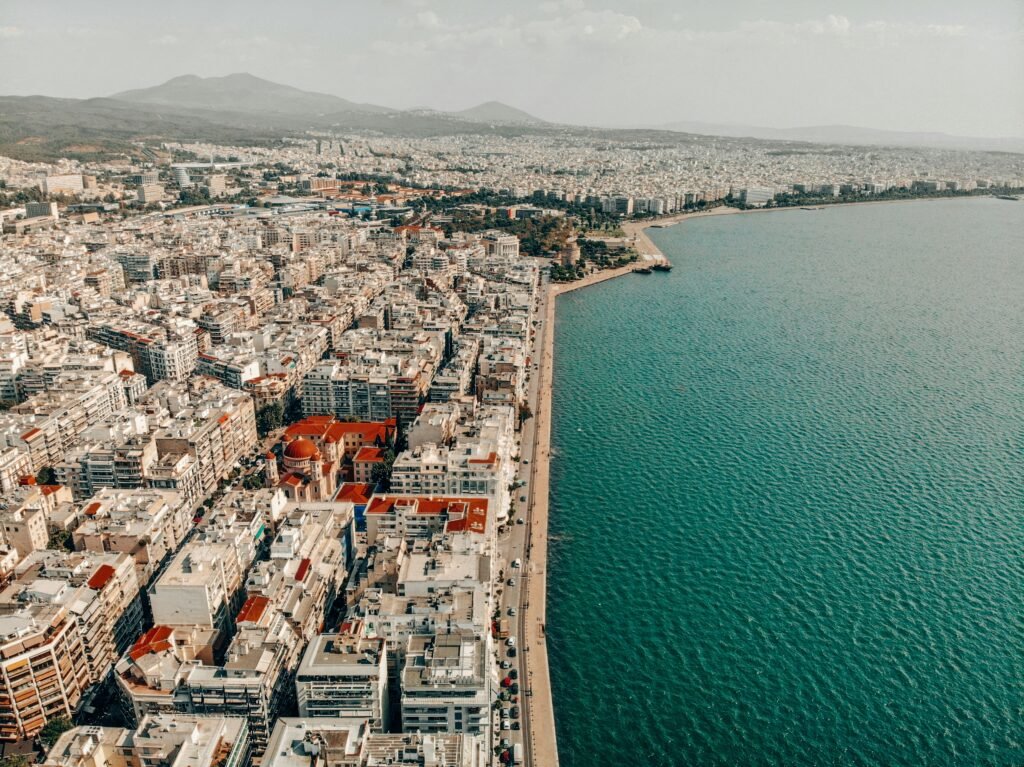
A five-kilometre promenade along the Thermaic Gulf with unobstructed sea views and some of the highest-quality residential stock in the city. A premium lifestyle address with year-round appeal. GV at €800K. Legal complexity is low to medium.
Kalamaria & Pylaia
Established residential districts favoured by families and professionals. Consistent long-term rental demand, strong yield profile relative to premium central districts, and an active new-build development corridor in Pylaia that is attracting Turkish and Israeli investors at the €800K threshold. Legal complexity is low for new-build stock, moderate for the older Kalamaria apartment inventory where unauthorised additions verification is standard.
Thermi
The premium suburban expansion zone east of the city. Luxury detached houses, modern residential complexes, international schools, and direct airport access. The choice for high-net-worth families — Turkish and Israeli in particular — seeking a primary family base in Greece with EU residency. Legal complexity is low. Land and planning compliance verification replaces the building legality focus of older urban stock.
How We Manage Your Acquisition in Thessaloniki
Every acquisition runs four parallel tracks — legal, technical, tax, and administrative — from our Thessaloniki office. Nothing is sequential; nothing waits for the prior step to complete.
- Legal setup: Greek tax number (AFM) registration and bank account assistance. Ownership structure advice, including GV eligibility verification for corporate structures (Private Company or SA) where applicable.
- Parallel due diligence: full title search at the Land Registry Office and historical records; independent engineer’s inspection coordinated by your legal team; master deed review; archaeological zone check where applicable. For €250K conversion projects: commercial registration verification, planning feasibility confirmation, and contract structure review.
- Contract and closing: purchase agreement drafted with protective clauses specific to the Thessaloniki context and to your specific pathway. For conversion projects, the unified notarial contract is the recommended structure. Remote representation through Power of Attorney if you are not present in Greece.
- Registration and post-purchase: ownership registered at the Land Registry Office and Tax Authorities. Ongoing availability for Golden Visa compliance, leasing, and estate planning.
Before Your Consultation: Five Questions Worth Asking
These questions define the legal and commercial risk profile of any property in Thessaloniki. You do not need answers before calling — they exist to make the first conversation more productive.
- Am I pursuing the standard €800,000 residential pathway or the €250,000 exception — and does my target property qualify for the specific pathway I am considering?
- For the €250,000 pathway: has the commercial registration status been formally verified at the Land Registry Office and the urban planning authority — and has the conversion’s planning feasibility been confirmed before any offer?
- Has an independent engineer — not the seller’s engineer — verified the building against its permits, and does the documented 120 m² meet the GV threshold as measured from the building permit?
- Does the property carry any archaeological zone obligations that could affect renovation permits or future development rights?
- Is my intended ownership structure — individual or corporate — aligned with GV eligibility requirements and my tax position? For Turkish or Israeli investors using a Private Company or SA, has the 100% shareholding condition been confirmed?
Frequently Asked Questions
What is the minimum investment for the Golden Visa in Thessaloniki?
Thessaloniki is classified as a high-demand area requiring a standard minimum of €800,000 in a single property of at least 120 m². Two legal exceptions allow entry at €250,000: commercial-to-residential conversion and listed building restoration. Investment thresholds and programme conditions are subject to legislative change — verify current requirements with your legal advisor before committing.
How does the €250,000 commercial-to-residential conversion exception work in Thessaloniki?
A property formally registered as commercial that is legally converted to residential use qualifies at €250,000 regardless of Thessaloniki’s high-demand zone classification. Three verifications are mandatory before any commitment: formal registration as commercial, planning feasibility for residential conversion, and an appropriate contract structure. The Ladadika district and the historic centre are the most relevant locations. The €250,000 threshold applies to the acquisition price; construction and conversion costs are separate.
What are the main legal risks when buying property in Thessaloniki?
The primary considerations are: unauthorised additions and regularisation entries in expansion-era apartment buildings; master deed ambiguities about exclusive versus communal spaces; archaeological zone obligations in central districts; the documentation requirements of the €250,000 exception pathways; and developer portfolio lock-in clauses in Viewing Forms for new-build acquisitions. All are manageable with independent legal representation and the right local expertise.
Is rental income strong in Thessaloniki?
Yes. Thessaloniki has one of the strongest structural rental demand profiles in Greece — driven by over 150,000 students, a growing technology sector, year-round medical tourism from the Balkans and Turkey, and the city’s role as the commercial hub of northern Greece. This creates consistent demand across multiple price points and tenant profiles, independent of tourism seasons.
Can I buy property in Thessaloniki remotely?
Yes. Through a Power of Attorney granted to Your Legal Home led by Kotsonis–Gaitanaki Law Firm, we manage the entire acquisition on your behalf — from AFM registration and bank account opening to notarial execution and Land Registry Office registration. Many international buyers complete the entire transaction without travelling to Thessaloniki until they choose to visit their property.
Are you a real estate agency?
No. Your Legal Home led by Kotsonis–Gaitanaki Law Firm is an independent law firm. We do not sell properties, earn agency commissions, or represent both sides of a transaction. We have no financial relationship with any agent, developer, or notary involved in transactions we advise on. We act exclusively on behalf of the client who has appointed us.
Begin Your Thessaloniki Investment with Legal Clarity
Whether you are entering at €800,000 in Kalamaria or exploring the €250,000 exception in Ladadika, whether you are a Turkish investor building an EU foothold or an Israeli investor pursuing the conversion arbitrage that most lawyers in this city don’t know to look for — the right starting point is a structured legal conversation about your goals, your timeline, and what the specific property you are considering actually requires.
→ Request Your Introductory Legal Consultation
A confidential discussion about your Thessaloniki investment goals and what sound legal protection looks like from the first property check to the final permit or title. Available by video call from anywhere, or in person at our Thessaloniki office.
Contact Your Legal HomeNo obligation to proceed.
Your Legal Home led by Kotsonis–Gaitanaki Law Firm — Where safety meets property.
Athens (Kifisia) · Corinthia · Zakynthos · Thessaloniki